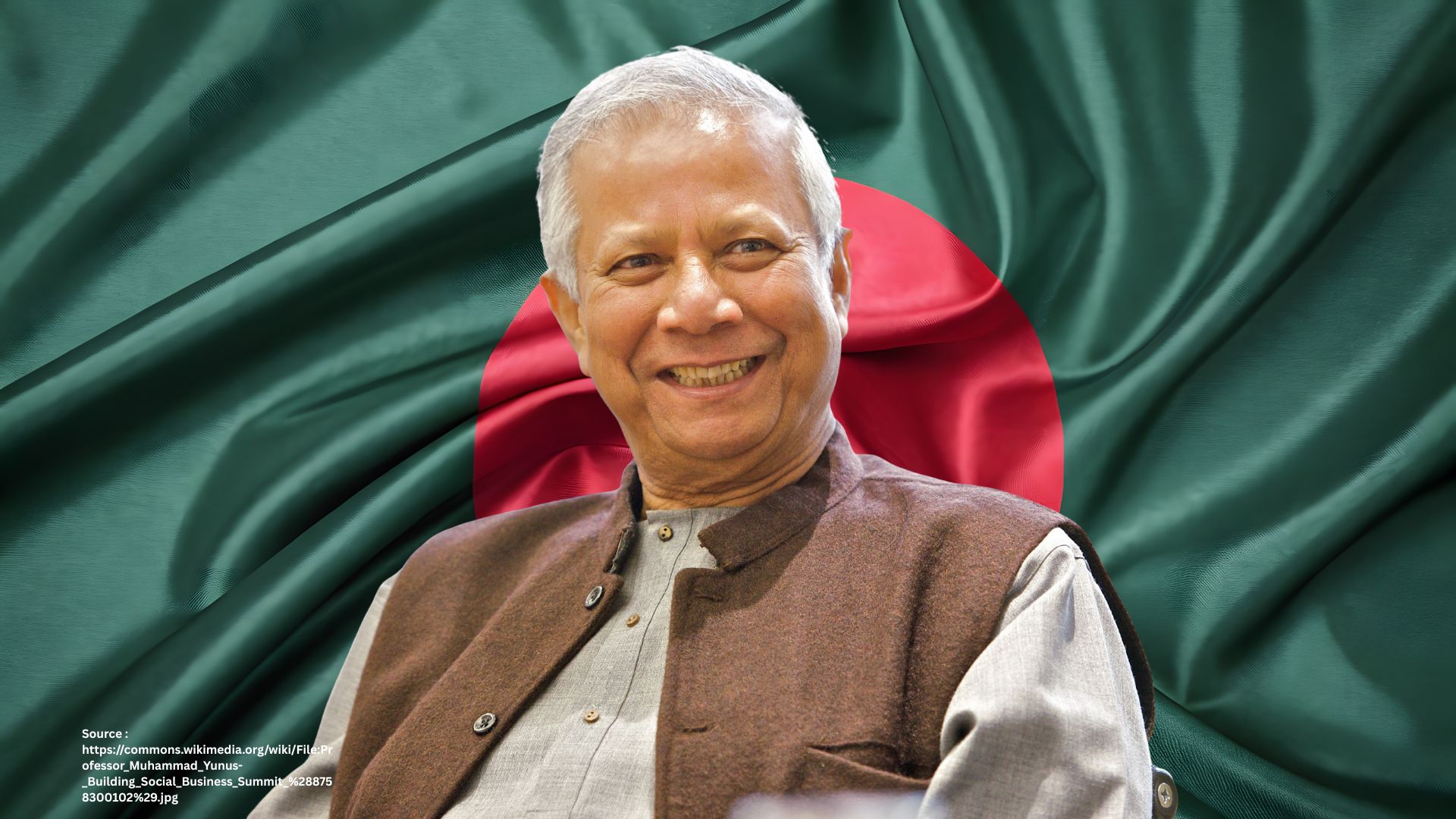
Dhaka, El Sky News – The story of Muhammad Yunus, Nobel Peace Prize–winning economist and founder of the microfinance revolution, is not the story of a man who simply studied poverty—it is the story of a man who walked into its heart, understood its silent cruelty, and built a solution that changed the lives of millions. His journey from a quiet academic to a global humanitarian figure is a testament to how a single idea, born from empathy, can reshape entire economic systems.
Yunus was born in 1940 in the port city of Chattogram, Bangladesh. As a child, he watched his parents extend kindness to those around them, unknowingly planting the seeds of his future mission. After excelling academically, Yunus earned a Fulbright scholarship that brought him to the United States, where he completed his PhD in economics. With a promising academic career ahead of him, he could have remained comfortably in classrooms and research halls. Instead, he returned home to a Bangladesh devastated by war, famine, and widespread poverty.

One visit to a village in the mid-1970s would alter the entire trajectory of Yunus’s life. As he spoke to local women trapped in cycles of debt, he discovered the painful truth: many were earning tiny profits—sometimes just a few cents—because they had to borrow money from exploitative lenders. The root of their suffering wasn’t laziness or lack of talent, but the absence of access to fair financial resources. Poverty, Yunus realized, wasn’t a personal failure; it was a structural trap.
Determined to break that cycle, he began lending small amounts of his own money to women who needed capital to rebuild their livelihoods—sometimes as little as $10. To his surprise, every loan was repaid. These women, empowered for the first time, began lifting themselves out of poverty. What started as a small experiment soon grew into the foundation of Grameen Bank, the world’s first institution dedicated entirely to microcredit for the poor.
What makes Muhammad Yunus profoundly inspiring is not just that he loaned money—it is that he redefined what poverty means and challenged the global assumption that the poor are “unbankable.” Yunus believed that people living in poverty are rich in potential but starved of opportunity. His model flipped traditional banking upside down: instead of collateral, he relied on trust; instead of focusing on the wealthy, he focused on the unheard; instead of intimidating borrowers, he empowered them.
Under his leadership, Grameen Bank helped millions of women start small businesses, gain financial independence, and secure better futures for their children. Yunus’s work proved that economic empowerment is one of the most effective tools against poverty—and that women, when given the chance, can transform entire communities.
In 2006, Yunus and Grameen Bank received the Nobel Peace Prize, not for charity, but for innovation that promoted lasting social change. The Nobel Committee described his work as an effort to “create economic and social development from below,” recognizing microfinance as a peaceful revolution in global economics.
Today, Muhammad Yunus continues to inspire new generations through his advocacy for “social business,” a model that prioritizes solving societal problems over making profits. His philosophy emphasizes that the purpose of business should not only be wealth, but also wellbeing, dignity, and opportunity for all.
What makes Yunus’s journey truly extraordinary is its simplicity: he saw people suffering and refused to accept it. Instead of theorizing, he acted. Instead of blaming the poor, he trusted them. His life stands as evidence that change begins when someone believes—deeply and unwaveringly—that humanity deserves better.
Muhammad Yunus’s legacy endures not as a man who loaned money, but as a man who restored hope, agency, and possibility to millions long forgotten by the world.