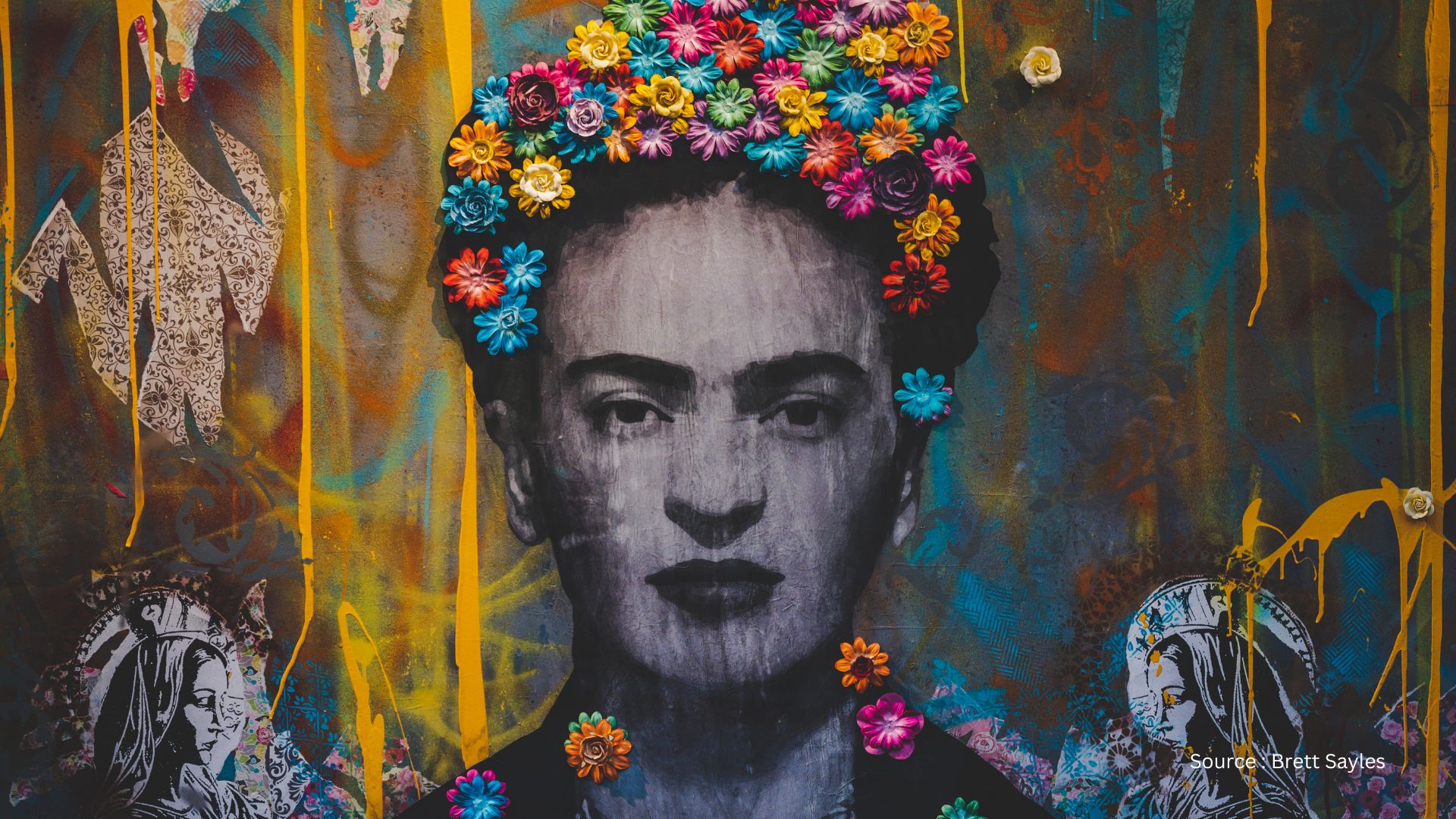
Mexico City, El Sky News – Decades after her passing, Frida Kahlo remains one of the most influential and inspiring figures in global art and culture. Known for her striking self-portraits, bold colors, and haunting visual symbolism, Kahlo’s journey was shaped not by comfort, but by relentless pain, resilience, and defiant self-expression.
Born in 1907 in Coyoacán, Mexico, Kahlo’s early life was marked by hardship from the start. At age six, she contracted polio, leaving one leg thinner than the other and forcing her to walk with a limp for the rest of her life. Yet even as a child, she refused to let physical limitations restrict her spirit—participating in sports traditionally reserved for boys and showing a fierce determination that would define her artistic identity.

Her life changed dramatically at the age of 18, when a catastrophic bus accident nearly killed her. The collision shattered her pelvis, spine, and legs, confining her to a full-body cast for months. During this period of unbearable pain and isolation, Kahlo discovered the one avenue that allowed her to remain alive in spirit: painting. Her mother arranged a special easel that allowed her to paint while lying in bed, and her father provided brushes and paints. What began as a form of survival slowly evolved into the visual language of a world-changing artist.
Kahlo’s paintings did not follow trends or traditional rules. Instead, they confronted the realities of her life—her broken body, her tumultuous relationship with Diego Rivera, her miscarriages, and her identity as a Mexican woman of mixed heritage. By painting her truth, she challenged societal expectations and reshaped global art with imagery that was raw, unapologetic, and deeply personal. Her self-portraits became a mirror not just of her own suffering, but of the universal struggle to endure, to transform pain into power, and to find beauty within brokenness.
Her home, La Casa Azul, became a haven for political thinkers, artists, and revolutionaries. Despite constant surgeries and lifelong medical complications, Kahlo continued painting with fearless honesty. Her works, once overshadowed by Rivera’s fame, eventually came to stand as symbols of feminist strength and emotional courage. Today, Frida Kahlo is celebrated not just as a surrealist icon, but as a woman who refused to let the world define her.
Her influence continues to shape modern discussions about identity, disability, gender, and self-expression. For many, Kahlo is a reminder that art can heal wounds that medicine cannot, and that even the most painful experiences can be transformed into something eternal.
“Frida taught the world that vulnerability is not weakness,” says one art historian. “It is the strongest form of truth an artist can give.”
From her physical struggles to her artistic triumphs, Kahlo’s life story stands as a testament to resilience. She remains a global symbol of courage—someone who broke, but never surrendered.