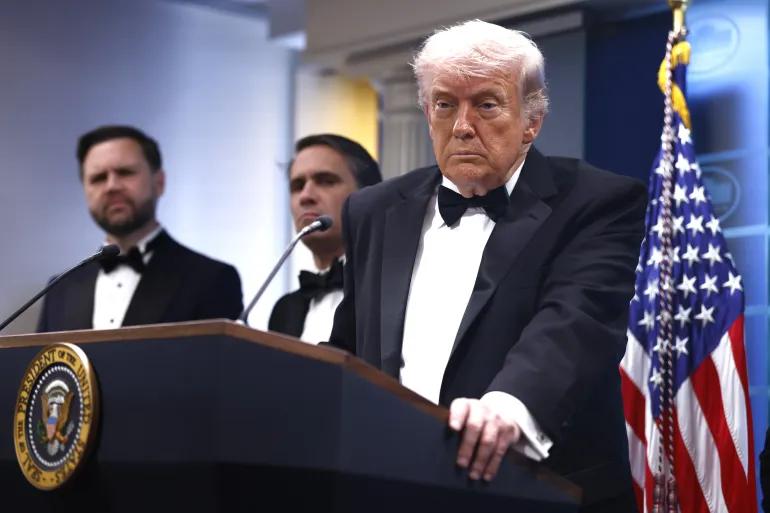
Washington, El Sky News— The Donald J. Trump administration officially released its latest National Security Strategy (NSS) on Friday, marking a significant shift in U.S. foreign policy and defense orientation. The new strategy revives the historic Monroe Doctrine, asserting that the Americas are the core sphere of U.S. influence while strengthening military presence across the hemisphere and reorganizing U.S. strategic priorities toward Europe and the Indo-Pacific.
Core Themes and American Priorities

The strategy frames U.S. foreign policy as “flexible realism”, emphasizing that actions abroad are guided primarily by what benefits America. The strategy also highlights the need for robust military capabilities in the Indo-Pacific, aimed at deterring Chinese influence in Taiwan, strategic shipping lanes, and other critical trade routes.
It prioritizes influence in the Western Hemisphere, asserting U.S. leadership in Latin America and the Caribbean, while combating illegal immigration, narcotics trafficking, and foreign interference under what analysts call the “Trump Corollary” to the Monroe Doctrine.
Firm Stance Toward Europe & Realignment of Alliances
The document warns that Europe faces a “civilizational erasure” if reforms are not implemented, citing demographic, migration, social, and political challenges as existential threats. It suggests that some NATO members could lose credibility as U.S. allies in coming decades, depending on internal demographic and political shifts. This signals a reduction in multilateral engagement, favoring bilateral relationships and direct regional influence instead.
Global Implications
Experts warn of far-reaching consequences from this strategic realignment:
- Latin America & the Caribbean: Countries may face increased U.S. military pressure, anti-narcotics operations, and stricter migration controls.
- Indo-Pacific Region: U.S. and allied military presence is likely to expand, potentially heightening tensions with regional powers and affecting geopolitical dynamics in the South China Sea and Taiwan Strait.
- Europe: European leaders have criticized the strategy, warning it undermines NATO solidarity and introduces uncertainty into transatlantic cooperation.
Critics argue the strategy signals a move away from liberal global leadership, from defending democracy and international order toward unilateral, nationalist, and regionalist policies, which could spark new global tensions.
A Turning Point in U.S. Global Policy
The 2025 National Security Strategy represents a dramatic shift in U.S. foreign policy from global alliances and multilateralism toward regional dominance, unilateral power projection, and nationalism. For countries in Latin America, Europe, and the Indo-Pacific, it signals a new era of geopolitical uncertainty, alliance adjustments, and potential conflict.
For readers, this is more than a headline it reflects a reconfiguration of global power structures. The phrase “sphere of influence” has returned as a core concept, suggesting that U.S. policy in the coming years may reshape the international order.