WASHINGTON — U.S. President Donald Trump signalled on Tuesday that the conflict between the United States and Iran could extend well beyond initial expectations, warning that the most significant phase of the military campaign is still ahead. His comments marked one of the most candid acknowledgements yet that the war may not be brief or limited.
The hostilities began over the weekend when U.S. and allied Israeli forces launched a major aerial strike against Iran, killing the country’s Supreme Leader, Ayatollah Ali Khamenei, and provoking a swift and widespread retaliation by Tehran. Explosions were reported in multiple capital cities, and Iran’s Revolutionary Guard launched missiles and drones against military and civilian sites across the Middle East.

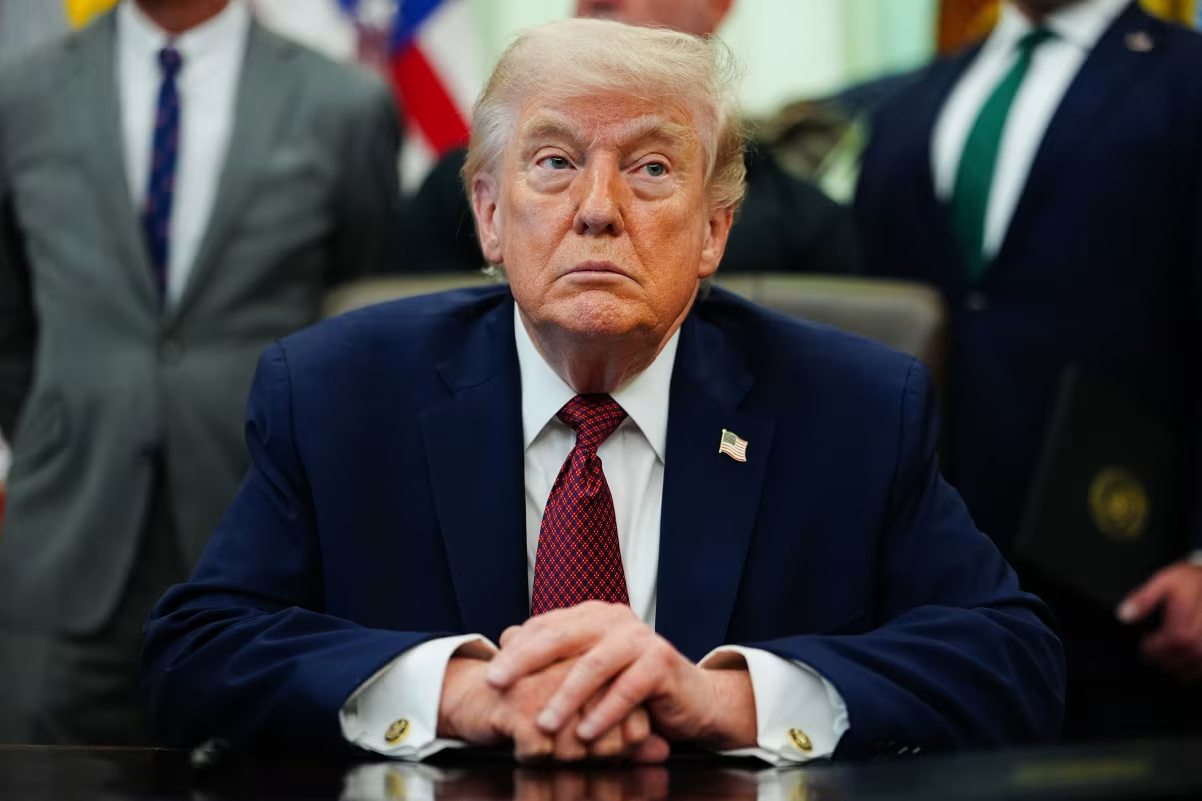
At a White House event, President Trump reiterated that the war — officially announced as a joint U.S.–Israel military operation — had thus far progressed “substantially.” However, he stressed that it was still in its early phases, telling reporters that “the big wave hasn’t happened yet.” The implication was clear: more intense military action was planned and potentially imminent.
Trump’s current public timeline for the campaign initially projected a four-to-five-week conflict, but the president admitted that U.S. capabilities allow for the effort to continue much longer if necessary. He clarified that the objectives — destroying Iran’s missile networks, crippling its navy and preventing nuclear ambitions — were separate from previous plans discussed in early briefings. Notably absent from his remarks was an explicit aim to topple Iran’s government.
Secretary of State Marco Rubio reinforced this message in subsequent statements, offering alternative explanations for how the U.S. became involved. According to Rubio, the U.S. did not initiate the attack unilaterally; instead, Washington acted after learning that Israel was prepared to strike Tehran on its own, prompting a pre-emptive American response to protect regional forces and U.S. personnel.
Despite Trump’s assurance that a prolonged engagement “is not endless,” his administration has refused to rule out deploying ground troops inside Iran, suggesting that the conflict’s direction could shift if deemed necessary. Defence officials indicated that they were prepared to escalate operations “as far as needed,” even though the Pentagon has not yet confirmed the presence of U.S. soldiers on the ground.
Iranian forces have intensified their own assault on regional targets, including strikes on Gulf states such as Bahrain, Kuwait, Qatar and the United Arab Emirates — actions Trump described as the “biggest surprise” so far. The expanding scope has prompted safety advisories urging American citizens to leave the Middle East.
The conflict’s toll has been significant. U.S. Central Command has reported at least six American personnel killed, while Iranian state media has claimed hundreds of casualties, including civilians. Meanwhile, Lebanon’s capital of Beirut has experienced heavy bombardment by Israeli forces targeting Hezbollah positions, resulting in dozens of deaths and widespread destruction.
The regional and global impact has been substantial. Oil markets surged on fears of disrupted shipping through the Strait of Hormuz, a vital artery for global energy supply. Countries in Europe and the Middle East have voiced deep concern over the conflict’s escalation, although diplomatic efforts to de-escalate remain minimal.
As the war enters what may be its most consequential phase, analysts suggest that the coming days and weeks could determine whether the conflict expands further or shifts toward negotiation and containment. For now, President Trump’s warning that the “big wave” of the campaign is yet to hit signals a conflict that may be far from over.