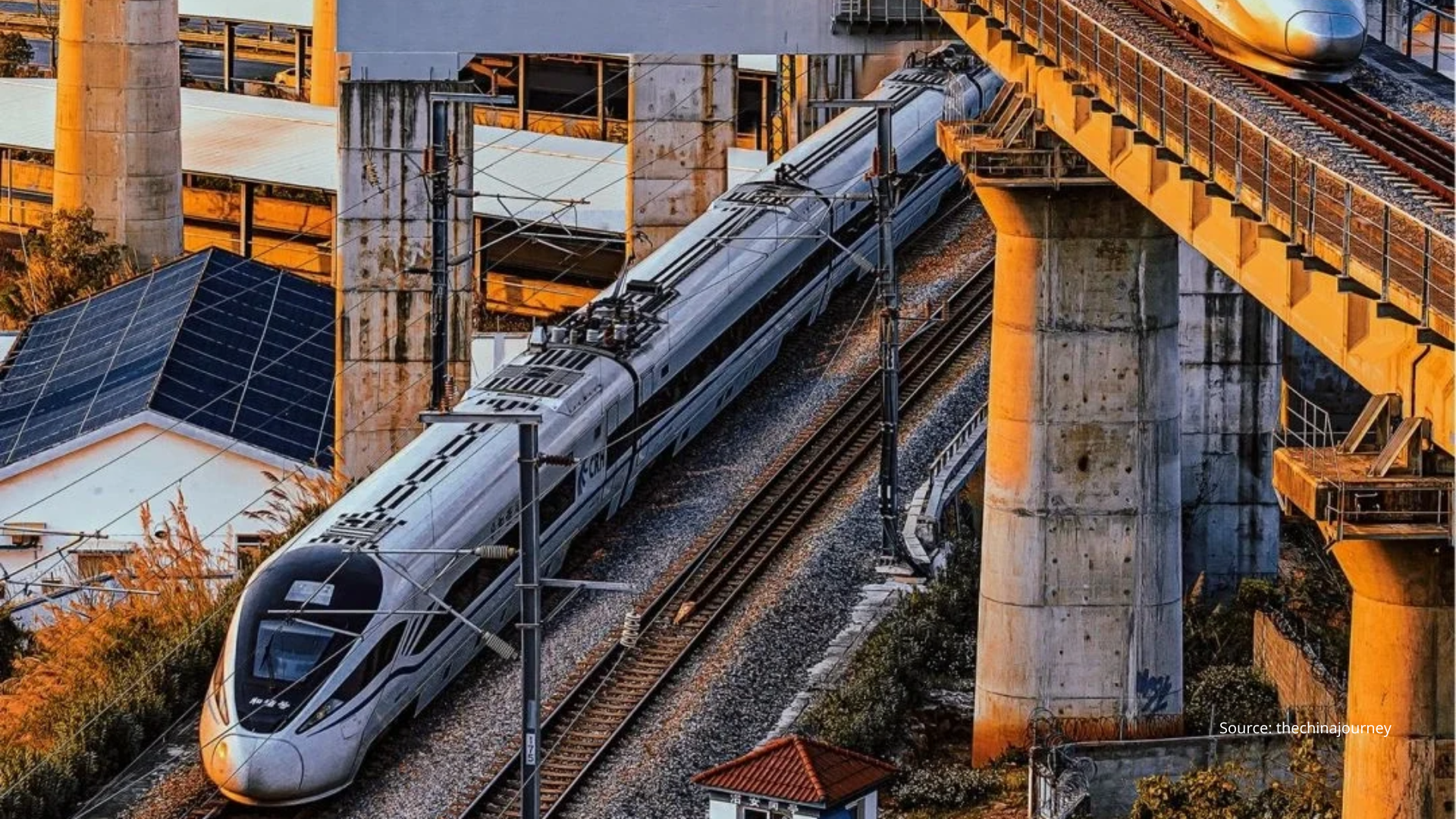
China, El Sky News — China has strengthened its position as the global leader in high‑speed rail after its network surpassed 50,000 kilometers in total operational length far exceeding the rest of the world’s high‑speed lines combined and as its trains routinely operate at speeds faster than Japan’s iconic Shinkansen system.
With the opening of the Xi’an–Yan’an high‑speed railway line on 26 December 2025, the vast Chinese high‑speed rail network now spans over 50,000 km, equivalent to more than one‑fifth of Earth’s circumference and exceeding the combined total of all other countries’ HSR systems.

Record Network Growth
State‑owned China Railway confirmed that the new Xi’an–Yan’an route which links the historic city of Xi’an with Yan’an in the country’s northwest contributed to the record‑breaking mileage. The journey on the new line can take as little as 68 minutes and includes trains that routinely operate at 350 km/h, faster than many bullet trains in Japan and Europe.
China’s rapid expansion up roughly 32 % faster than in 2020 reflects the nation’s long‑term ambition to enhance connectivity between cities and regions, and further integrate its economy through rail infrastructure.
Speed Comparisons: China vs. Shinkansen
While Japan’s Shinkansen has long been recognized as the pioneering high‑speed rail system, most bullet trains on Japan’s network operate at top speeds around 320 km/h on services such as the Tokaido and Tohoku lines.
China’s C9309 train running on the Xi’an–Yan’an line routinely reaches 350 km/h (217 mph), surpassing the normal top speed of Shinkansen services. This showcases how Chinese high‑speed trains are not only extensive in network coverage but also competitive in speed performance.
Additionally, China has been developing new train models, such as the CR450 prototype, which is expected to reach operational speeds of up to 450 km/h, potentially setting new benchmarks in commercial train travel if brought into service.
Maglev and Future Technologies
Beyond conventional high‑speed rails, China also leads globally in maglev (magnetic levitation) technology, which allows trains to float above tracks using magnets and achieve extraordinary speeds. Trials and research indicate potential maglev systems capable of exceeding 600 km/h, rivaling the cruising speeds of some aircraft.
Although maglev networks have not yet been expanded into full national trunk lines, the research and development efforts suggest that China’s rail innovation continues to push technological boundaries beyond traditional HSR systems.
Economic and Strategic Implications
China’s high‑speed rail infrastructure has transformed domestic travel, reduced journey times between major cities, and contributed to economic integration across provinces. Analysts note that these extensive rail connections not only enhance mobility but also support regional development and city expansions.
Moreover, as China continues to build and finance rail projects abroad through initiatives such as the Belt and Road Initiative, the country’s rail expertise becomes a strategic export, influencing transportation infrastructure globally.
(Lunar)