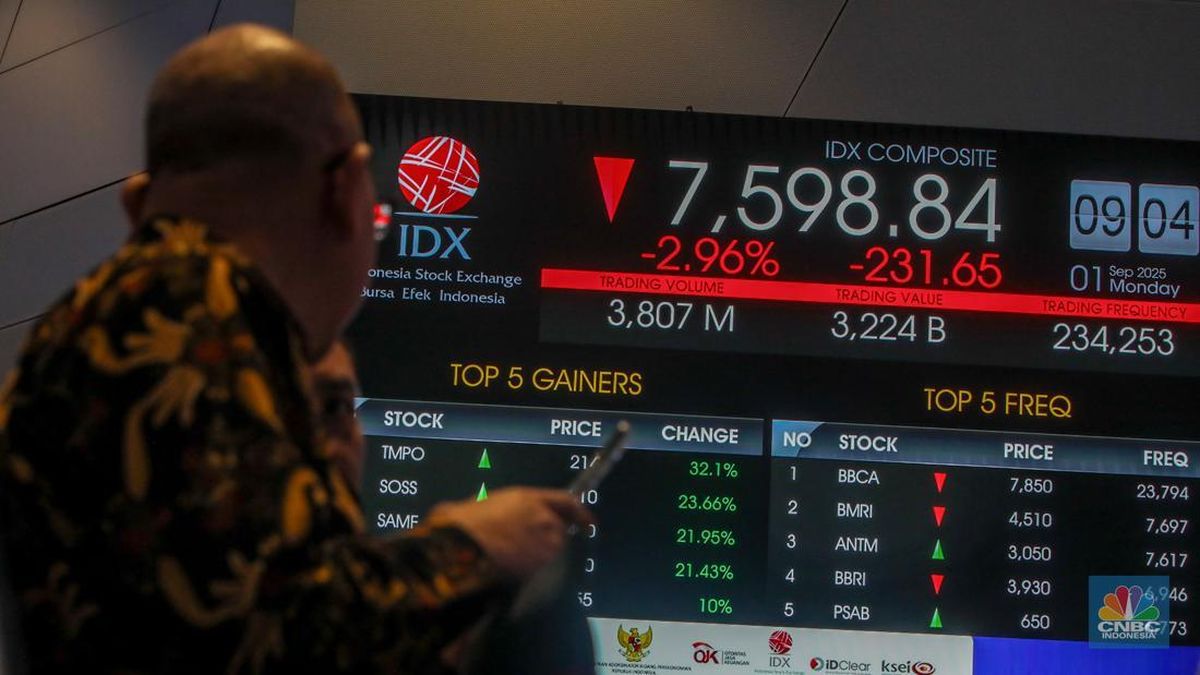
JAKARTA – The Indonesian stock market faced a “Black Wednesday” as the IHSG (Indonesia Composite Index) plummeted over 6.5% during the opening session on January 28. The crash was triggered by a “perfect storm” of regional geopolitical instability—involving North Korean missile tests and a Chinese espionage scandal—combined with a surprise decision by global index provider MSCI to cut Indonesia’s weight.
Geopolitical Chaos: China and North Korea
The initial tremors began in East Asia. Reports of a high-level investigation into General Zhang Youxia, China’s top military official, for allegedly leaking nuclear secrets to the U.S., sent shockwaves through regional markets.

This instability was compounded as North Korea fired a series of short-range ballistic missiles into the East Sea. The move was a defiant response to the U.S. shifting its defense strategy toward South Korean “self-reliance.” International investors, fearing regional escalation, began a rapid retreat from emerging markets like Indonesia to seek shelter in “safe-haven” assets.
The MSCI Blow: A Direct Hit to Jakarta
While geopolitical tensions weakened market sentiment, the “death blow” came from MSCI (Morgan Stanley Capital International). In its latest rebalancing, MSCI announced a significant reduction in Indonesia’s weighting within its global indices.
This triggered an immediate, automated sell-off by global fund managers who track the MSCI as a benchmark. The IHSG dropped 6.53% almost instantly, hitting its lowest psychological level of the year.
Major Casualties: Banking and Blue Chips
The carnage spared no one, but Indonesia’s “Big Cap” stocks—the backbone of the Jakarta exchange—hit the hardest:
- Banking Giants: Top lenders like BBCA (Bank Central Asia) and BBRI (Bank Rakyat Indonesia) saw massive selling pressure, hitting their lower trading limits.
- Telecommunications & Consumer: Major players like Telkom Indonesia (TLKM) and Astra International (ASII) dropped significantly, further dragging down the index.
Regulatory Response
Following the drop of over 5%, the Indonesia Stock Exchange (IDX) prepared for a potential Trading Halt—a mandatory cooling-off period designed to prevent further panic selling and extreme volatility.
Outlook
Analysts warn that as long as tensions in the Korean Peninsula remain high and the U.S. Dollar continues to strengthen under “America First” policies, the Indonesian market will remain under heavy pressure. The sudden capital outflow has also put the Indonesian Rupiah under strain, marking a challenging start to the 2026 economic year for Southeast Asia’s largest economy.
( Rahul Rezky )