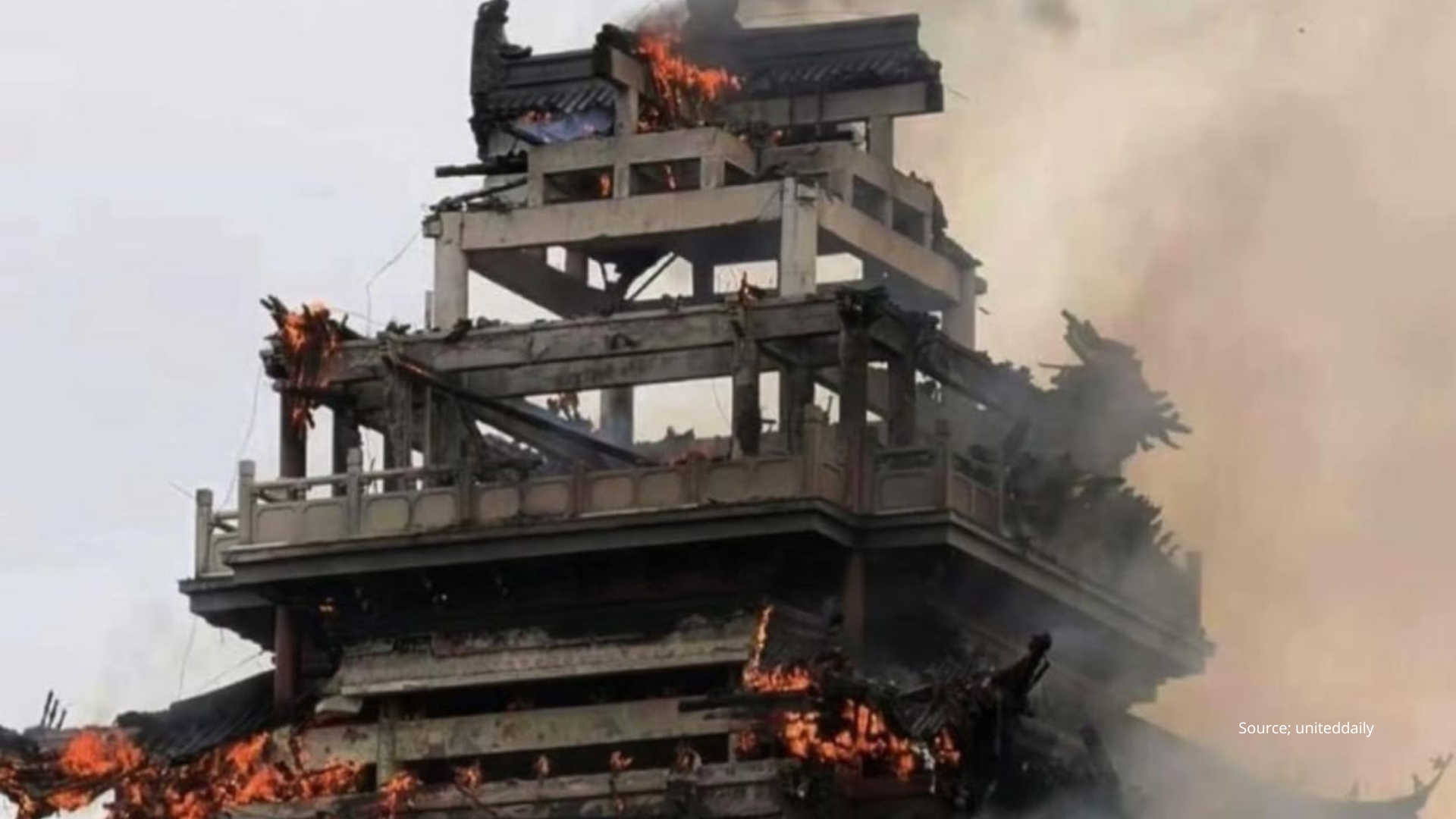
Zhangjiagang, El Sky News – A major fire devastated the three-story Wenchang Pavilion within the Yongqing Temple complex in Zhangjiagang, Jiangsu Province, China, on November 12, 2025. Videos widely circulated on social media showed the blaze rapidly consuming the entire wooden structure of the pavilion, with thick, black smoke billowing into the sky.
Cause of Fire: Improper Use of Incense and Candles

Preliminary investigations by local authorities concluded that the fire was likely caused by the improper use of incense and candles by a visitor. Reports indicate that the irresponsible use of these ritual items triggered the disaster within the wooden structure of the pavilion. Zhangjiagang city authorities stated they would pursue accountability after the full investigation is completed.
Impact and Damage
- Casualties: It was reported that no casualties or injuries occurred during the incident.
- Structural Damage: The Wenchang Pavilion was completely destroyed by the fire. According to reports, only the concrete frame of the pavilion remained intact after the blaze.
- Fire Spread: Firefighters successfully contained the fire and prevented it from spreading to the surrounding forest area, which is part of Fenghuang Mountain.
Status of the Burnt Building
Although Yongqing Temple as a whole boasts a long history of approximately 1,500 years dating back to the Liang Dynasty (536 CE) and known as a historically significant site the burnt Wenchang Pavilion was a relatively recent structure.
- Recent Construction: The destroyed Wenchang Pavilion was built between 2008 and completed in 2009. While constructed in a traditional architectural style, the building was not an ancient architectural relic and did not house cultural artifacts.
- Main Temple: The Yongqing Temple itself underwent reconstruction in the 1990s after its original structures were destroyed in 1958.
Yongqing Temple is situated on Fenghuang Mountain and is managed by the historic Yongqing Temple complex. The site holds cultural significance, including being where the legendary Chinese writer, Shi Naian, is believed to have lived and written parts of his classic novel, Water Margin.
Follow-up and Prevention Efforts Authorities have pledged to take appropriate action based on the investigation’s findings. They also announced that safety measures and security inspections would be intensified at cultural sites and temples across the region to prevent similar incidents in the future. Restoration work on the Wenchang Pavilion, which will be rebuilt in the traditional architectural style, is expected to commence once the investigation concludes.