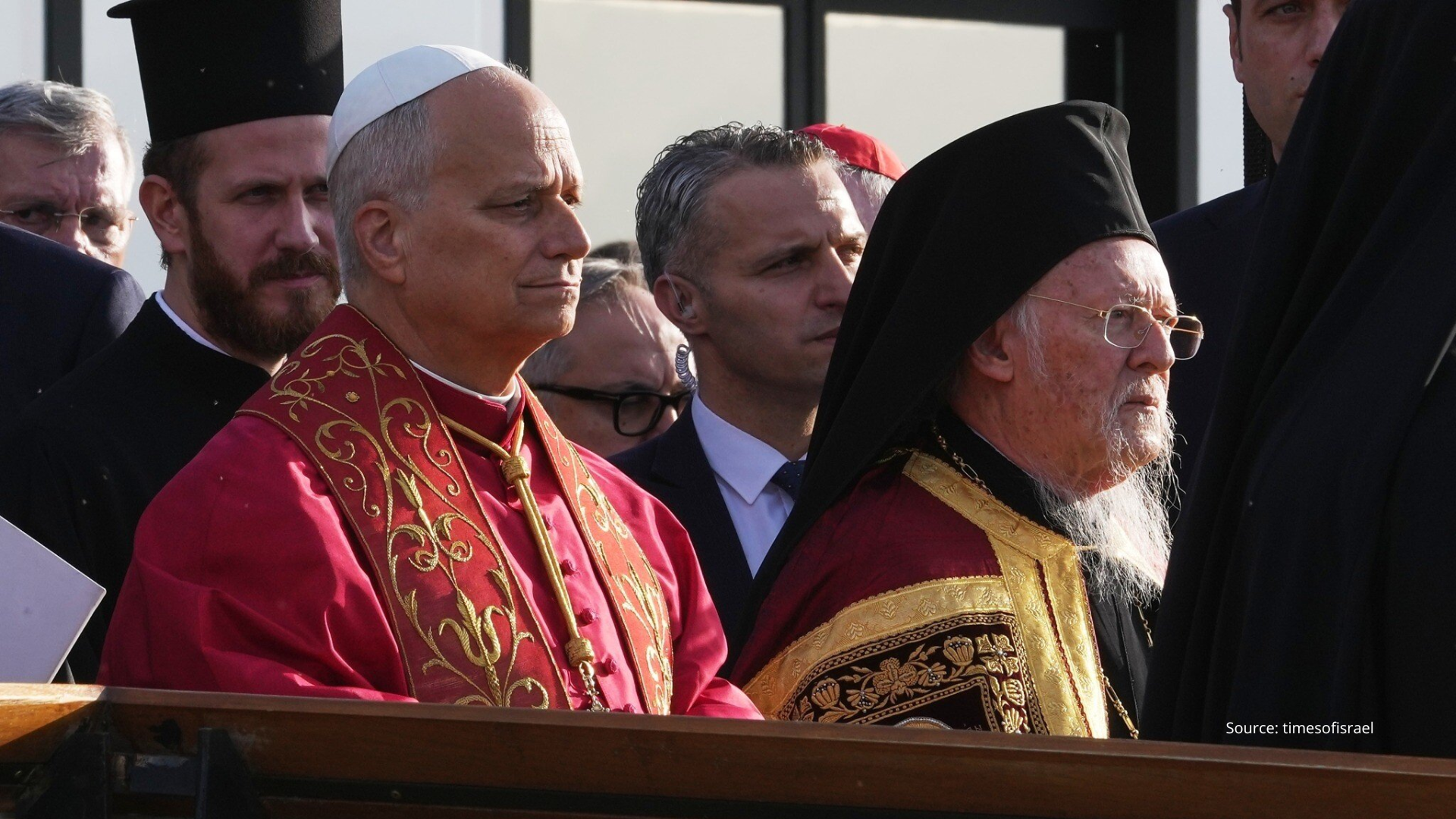
Turkey — El Sky News – On Friday, 28 November 2025 (local time), Pope Leo XIV led an ecumenical prayer with church leaders from the Middle East at a historic site the former location of the Council of Nicaea (now Iznik, Turkey). The event commemorated 1,700 years since the First Council of Nicaea (325 AD), where the foundational Nicene Creed of the Christian faith was formulated.
The meeting was attended by leaders and representatives from various Christian denominations Catholic, Orthodox, Protestant, and other Eastern communities including Bartholomew I, Patriarch of Constantinople, as well as bishops and priests from countries such as Turkey, Egypt, Syria, and Israel.

Messages from Pope Leo XIV
During his sermon and prayer, Pope Leo XIV emphasized that:
- All of humanity, amidst current global conflicts and violence, “calls for reconciliation.”
- “We must firmly reject the use of religion to justify war, violence, or any form of fundamentalism and fanaticism.”
- The path forward lies in fraternal encounters, dialogue, and cooperation. The Pope also expressed regret that, despite there being 2.6 billion Christians worldwide, it is unfortunate that they remain divided into numerous denominations even though early Christianity was founded on the principle of unity.
Event Atmosphere & Reactions
The ecumenical prayer took place near the ruins of an ancient basilica believed to be the original site of the First Council of Nicaea by the lake in Iznik. Worshippers from various Christian traditions prayed together in English, Greek, and Arabic, lighting candles as symbols of peace.
Although the majority of Turkey’s population is Muslim, the meeting proceeded under tight security. A small Islamic party staged a brief protest, expressing concerns that the event might threaten national identity though no major disturbances occurred.
For the minority Christian community in Turkey, the Pope’s visit offered moral support and a renewed sense of hope showing that religious diversity can be respected, and interfaith or intra-Christian dialogue is possible.
Global Significance & Implications
- Message of Christian Unity & Rejection of Fanaticism: Pope Leo’s statement is highly symbolic at a time when the world faces conflicts driven by religion and identity from the Middle East to Europe. His call to reject violence in the name of faith serves as a cross-faith moral momentum.
- Inter-denominational Dialogue: By bringing together leaders from multiple Christian traditions (Catholic, Orthodox, Protestant), the event highlights the potential for reconciliation and collaboration among churches that have long been divided.
- Turkey as a Meeting Point of Faith & Christian History: Choosing Iznik the site of Nicaea underscores the importance of Christianity’s historical roots and the idea that religion can be a bridge, not a cause of conflict.
- Reflection on Global Crises & Conflicts: Amid wars, refugee crises, and religious tensions, Pope Leo’s call for peace, tolerance, and dialogue stands out as a crucial humanitarian message.
Pope Leo XIV’s visit to Turkey and the historic meeting in Iznik was not merely a religious ritual, but a moral and political statement: religion must never be used as a justification for violence, and unity and interfaith dialogue are paths toward peace.
For the international community both Christian and interfaith this moment offers new hope that the future can be built on respect, tolerance, and shared humanity