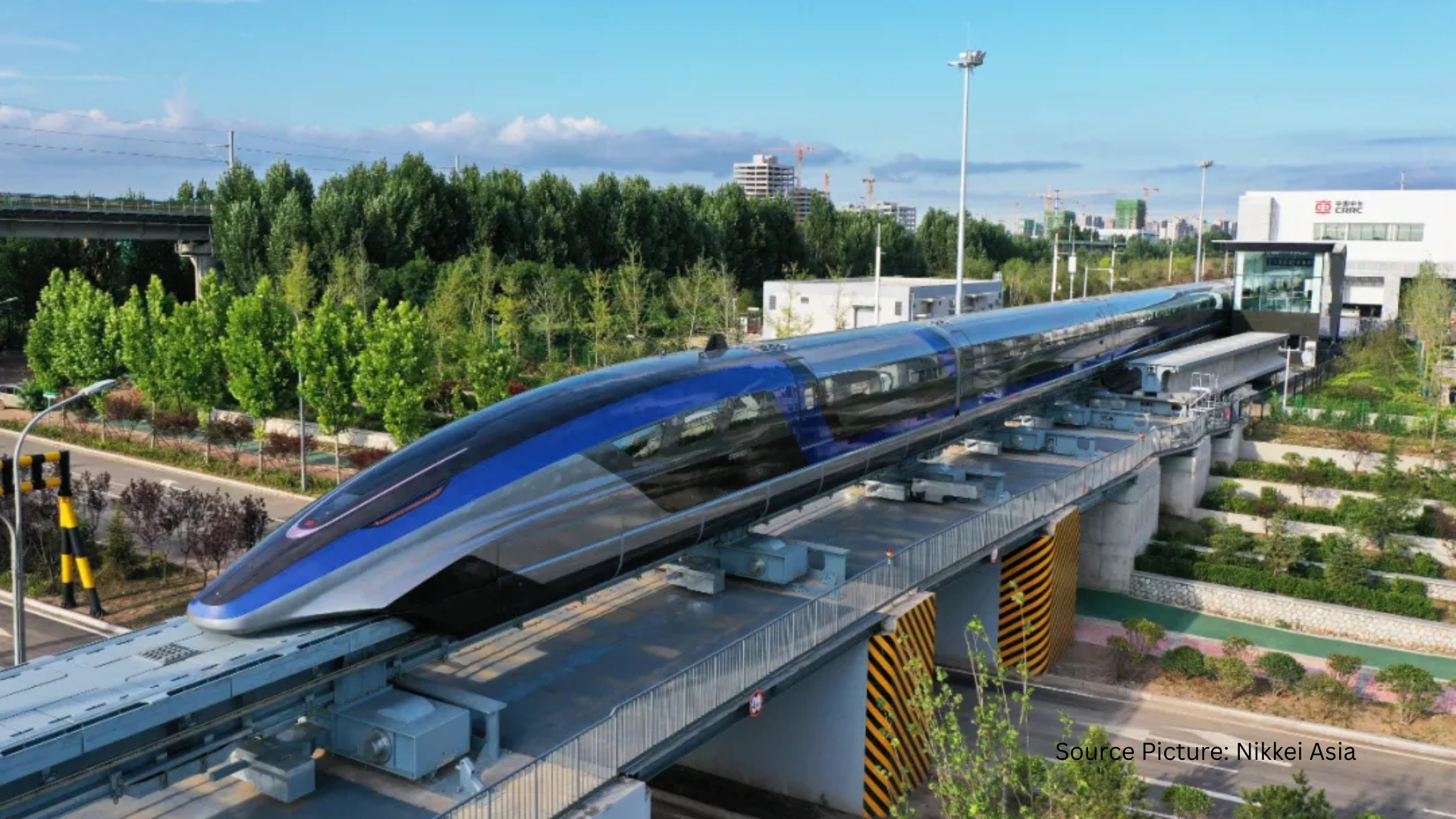
YAMANASHI, JAPAN, El Sky News – In a breathtaking display of engineering prowess, Central Japan Railway (JR Central) successfully conducted a public trial of its latest Superconducting Maglev (SCMaglev) train today, January 6, 2026. The test, held at the Yamanashi Maglev Test Track, saw the next-generation prototype reach a staggering speed of 600 km/h, reinforcing its status as the fastest and most energy-efficient ground transportation system in the world.
This latest trial marks a significant milestone in the development of the Chuo Shinkansen line, which aims to connect Tokyo and Nagoya in just 40 minutes, effectively halving the travel time of current bullet trains.

The Pinnacle of Magnetic Levitation Unlike traditional trains that rely on wheels and tracks, the SCMaglev utilizes powerful superconducting magnets to levitate the carriage approximately 10 centimeters above the guideway. By eliminating friction from the rails, the system can achieve aircraft-level speeds with remarkable stability. Key technical highlights from today’s test include:
- Holo-Magnetic Efficiency: The new 2026 prototype features an upgraded magnetic cooling system that reduces energy consumption by 20% compared to previous models.
- Whisper-Quiet Transit: Despite its immense speed, the train is designed with advanced aerodynamics to minimize “tunnel boom” and external noise, making it one of the most environmentally friendly high-speed options available.
- AI-Guided Safety: The trial successfully demonstrated the train’s automated safety response, which uses real-time AI to adjust levitation height and speed in response to seismic vibrations.
A Professional Vision for Connectivity The successful 600 km/h run is not just about speed; it is about redefining the professional commute. Once the Chuo Shinkansen becomes operational, the “one-hour economic zone” connecting Tokyo, Nagoya, and eventually Osaka is expected to spark a massive surge in regional business productivity and tourism.
“Today’s trial is a friendly invitation to the world to witness the future of mobility,” a spokesperson for JR Central stated. “Our goal is to provide a transit experience that is not only incredibly fast but also deeply sustainable. We are building a bridge between cities that will change how people live and work in the coming decades.”
On Track for the 2030s While the project has faced geological and budgetary challenges, today’s flawless performance provides a boost of confidence for stakeholders. The commercial version of the train is expected to operate at a standard speed of 500 km/h, ensuring a comfortable and reliable journey for thousands of daily passengers.
A Global Benchmark With China and Europe also racing to develop high-speed maglev systems, Japan’s 2026 trial serves as a professional benchmark for the industry. International observers have lauded the safety record of the Yamanashi test track, which has hosted thousands of successful runs since its inception.
As the sun sets over Mount Fuji, the sound of the future echoing through the Yamanashi valley serves as a reminder: the era of 600 km/h ground travel is no longer a dream—it is a reality in motion.
(Leakim Otid)