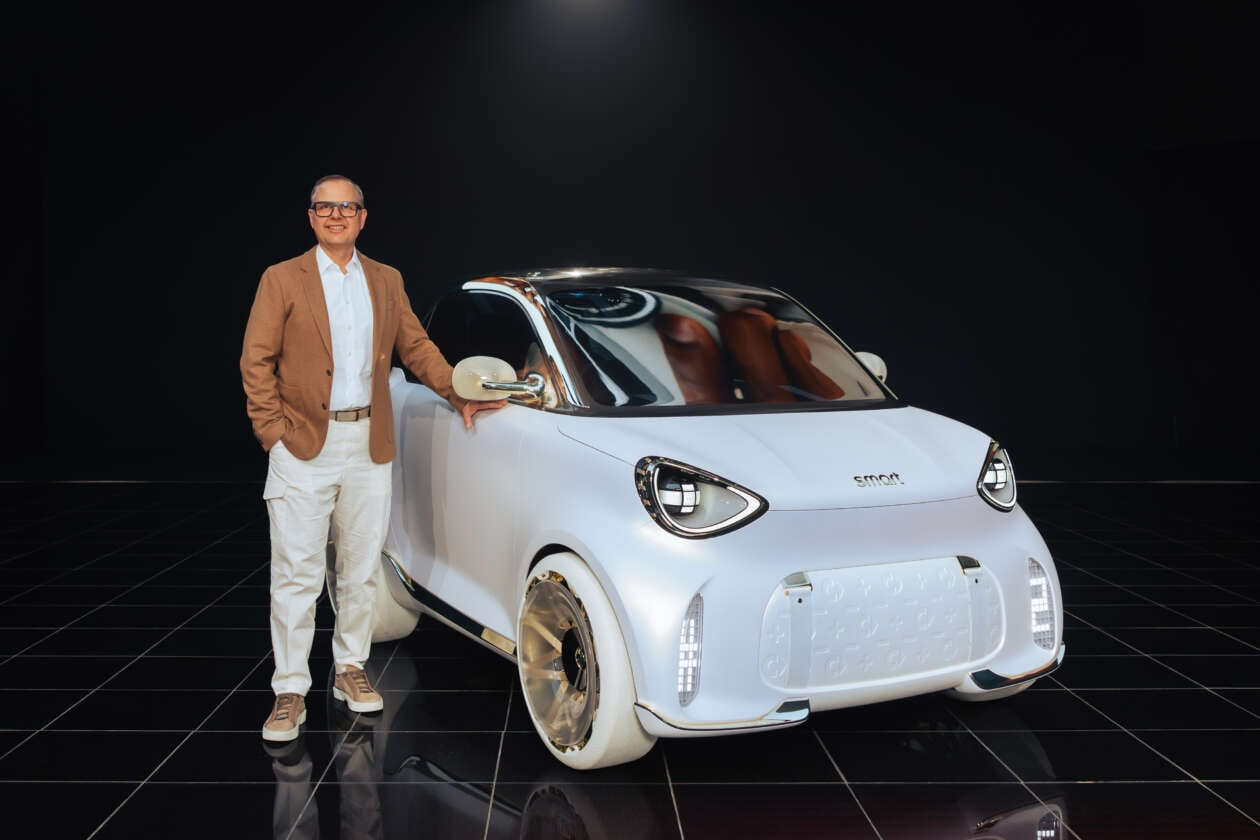
KUALA LUMPUR, April, 2026 — The smart Concept #2 has officially been revealed as a next-generation ultra-compact electric city car, previewing a production model that will revive the brand’s iconic two-seater formula.
Developed under the joint venture between Mercedes-Benz and Geely, the Concept #2 signals a strategic return to smart’s original identity as a maker of small urban mobility solutions, following several years of expansion into larger EV segments.

The production version is expected to make its global debut in October 2026, with potential rollout in Europe, China, and selected international markets — including Malaysia through Proton’s future EV lineup strategy.
The smart Concept #2 is designed as a fully electric two-seater urban vehicle, inspired by the legacy of the original smart fortwo.
Key highlights include:
- Ultra-compact city-focused design
- Two-seat configuration for urban mobility
- Fully electric drivetrain
- Target driving range of under 300 km
- Lightweight architecture optimized for efficiency
The model is intended for dense urban environments, where compact size and maneuverability are more important than long-distance performance.
The Concept #2 has been styled by the global Mercedes-Benz design team, ensuring a premium design language despite its compact footprint.
According to early previews, the vehicle features:
- Minimalist aerodynamic exterior
- Short overhangs for tight urban navigation
- Futuristic LED lighting signatures
- Compact proportions inspired by the original smart fortwo
The model is currently in its final development phase, with production expected to take place in China under smart’s manufacturing ecosystem.
Unlike larger EVs focusing on long-distance travel, the Concept #2 is built strictly for city use.
Expected specifications include:
- Electric range: below 300 km (urban-focused use case)
- Fast charging capability (exact figures yet to be confirmed)
- Lightweight EV platform for efficiency
- Optimized battery size for cost and compact packaging
The vehicle prioritizes efficiency, affordability, and urban practicality over high-performance metrics.
After expanding its lineup to larger EVs such as the smart #1, #3, and #5, the Concept #2 represents a strategic reversal toward compact mobility.
Industry analysts view this as:
- A response to rising urban congestion
- A push toward affordable EV entry models
- A revival of smart’s original brand identity
The move positions smart to compete in the growing micro-EV segment alongside emerging Asian and European city car manufacturers.
One of the most significant developments is the potential link to Malaysia.
Reports indicate that the Concept #2 could enter the Malaysian market under Proton’s future EV collaboration strategy, following the brand’s broader partnership ecosystem with global automotive players.
Malaysia’s EV roadmap, supported by Proton’s electrification push, suggests that compact urban EVs could play a role in:
- Affordable city mobility solutions
- Urban electrification goals
- Expansion of local EV assembly and distribution
The unveiling of the Concept #2 reflects a growing global trend toward:
- Compact electric vehicles for urban centers
- Lower-cost EV ownership models
- Sustainable transportation in congested cities
- Reduced carbon footprint mobility solutions
As cities worldwide tighten emissions regulations, demand for small EVs is expected to rise significantly.
The smart Concept #2 marks a bold return to the brand’s roots, combining ultra-compact design with modern electric technology.
With its two-seat configuration, sub-300 km range, and urban-focused engineering, the model aims to redefine city mobility for the next generation.
Its expected launch in October 2026 — and potential entry into Malaysia through Proton’s EV ecosystem — positions it as a key model in the evolving global micro-EV segment.